Turn Customer Complaints Into 5-Star Reviews Using AI: The HEARD Method
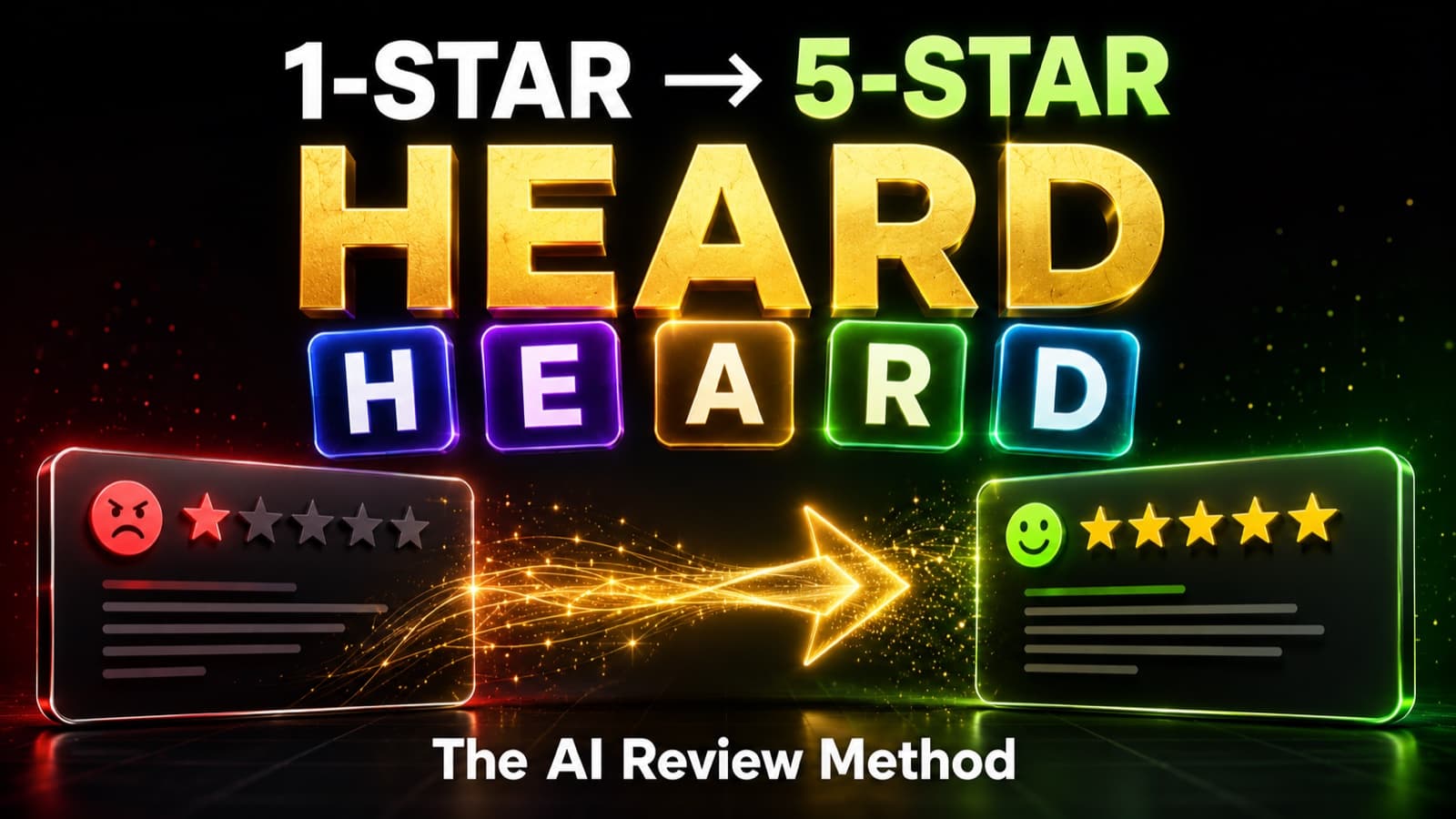
Ignoring a bad review, getting defensive, or pasting "we apologize for any inconvenience" all cost you trust. HEARD — Hear, Empathize, Apologize, Resolve, Delight — is a five-step way to answer any complaint in public, and AI can draft it in seconds.
By Garvit Jain, Vardhan AI
Every business gets a bad review eventually. What decides whether it costs you customers or wins you some is the reply — because the next person deciding whether to visit isn't only reading the complaint. They're reading how you handled it.
The 3 Replies That Kill Trust
- Ignoring it. Silence tells every future customer that nobody's listening.
- Getting defensive. "Our records show the delivery was on time…" Even when you're right, you've just confirmed the reviewer's frustration — and readers side with the person who feels attacked.
- The generic template. "We apologize for any inconvenience and appreciate your feedback." Everyone has read it a thousand times. It proves nobody actually read the complaint.
There's a better way to reply, and it's a repeatable structure — which is exactly what makes it a good job for AI. It's also backed by research pointing the same direction: a Harvard Business Review write-up of a study of hotel reviews by Davide Proserpio and Giorgos Zervas is titled "Study: Replying to Customer Reviews Results in Better Ratings."
The HEARD Method
Five steps: Hear, Empathize, Apologize, Resolve, Delight.
H — Hear
Mirror back exactly what went wrong. Not "we're sorry for your experience" — the specific problem:
We understand your order arrived three days late and the packaging was damaged.
Specificity proves a human (or a well-briefed AI) actually read the review. That alone takes the heat out of most complaints.
E — Empathize
People write reviews because they felt something. Acknowledge the feeling, not just the facts:
That's frustrating, especially when you needed it for an important occasion.
A — Apologize
One clean apology. Three rules: no "but" or "however", no blaming a courier or a supplier, and no "any inconvenience" minimising. One sentence, then move on:
We fell short of the standard you deserve, and we're sorry.
R — Resolve
Put the fix in the public reply. "Please contact our support team" pushes the problem behind closed doors and leaves readers wondering what you're hiding. Say what you've actually done:
We've shipped a replacement with expedited delivery and credited ₹500 to your account.
D — Delight
Go one step past the fix — something small and unexpected that shows you value the relationship:
- A complimentary upgrade or bonus item
- An extended warranty or trial
- A personal note from the owner
- Early access to something new
The fix settles the complaint; the surprise is what makes someone tell other people about how you handled it.
HEARD in Action: A Restaurant Review
The review: "Waited 45 minutes for food. My steak came out overcooked. Really disappointing."
The HEARD reply: "You waited 45 minutes and your steak arrived overcooked — that's not the experience we promise. (Hear) A long wait when you're hungry and looking forward to a good meal is genuinely frustrating. (Empathize) We fell short, and we're sorry. (Apologize) We'd like to make it right: dinner for two is on us — just show this reply to the host on your next visit. (Resolve) We've also shared your feedback with our kitchen team, and we'd like you to try our chef's tasting menu, on the house, so you can see what we're capable of. (Delight)"
Notice what a reader sees: a business that listened, owned it, fixed it in public and went further. That reply is doing more marketing than the same restaurant's five-star reviews.
Why AI Is the Right Tool for HEARD
Writing a thoughtful HEARD reply by hand takes real time. For a business with several locations, or one that lists on Google, Zomato and travel sites, replies pile up — and that's when they get ignored or answered with a template.
HEARD works because it's a fixed structure with variable content, and that's what AI is good at. An AI drafting assistant can:
- Read each review and pull out the exact issue and the emotion behind it
- Draft a reply in all five steps, in your brand's voice
- Apply your policies — what you can offer as a fix or a gesture — so it never promises what you won't honour
- Escalate to a human when a complaint is serious, legal or sensitive
The human stays in charge of judgement calls; the AI removes the blank page and the delay.
Try It Today
- Open your last five negative reviews
- Rewrite each reply using the five HEARD steps
- Post them, and watch how the reviewers — and later readers — respond
Want this running across every review platform, in your voice, with your policies built in? That's the kind of AI Coworker we build at Vardhan AI. Talk to us →