The 7-Prompt AI Stack That Runs Our Entire Business (Copy These)
Sales emails, client research, content ideas, meeting prep, proposals, follow-ups, and weekly reports — seven prompts we paste into AI every single day, word for word. Copy them, swap in your own details, and use them today.
By Garvit Jain, Vardhan AI
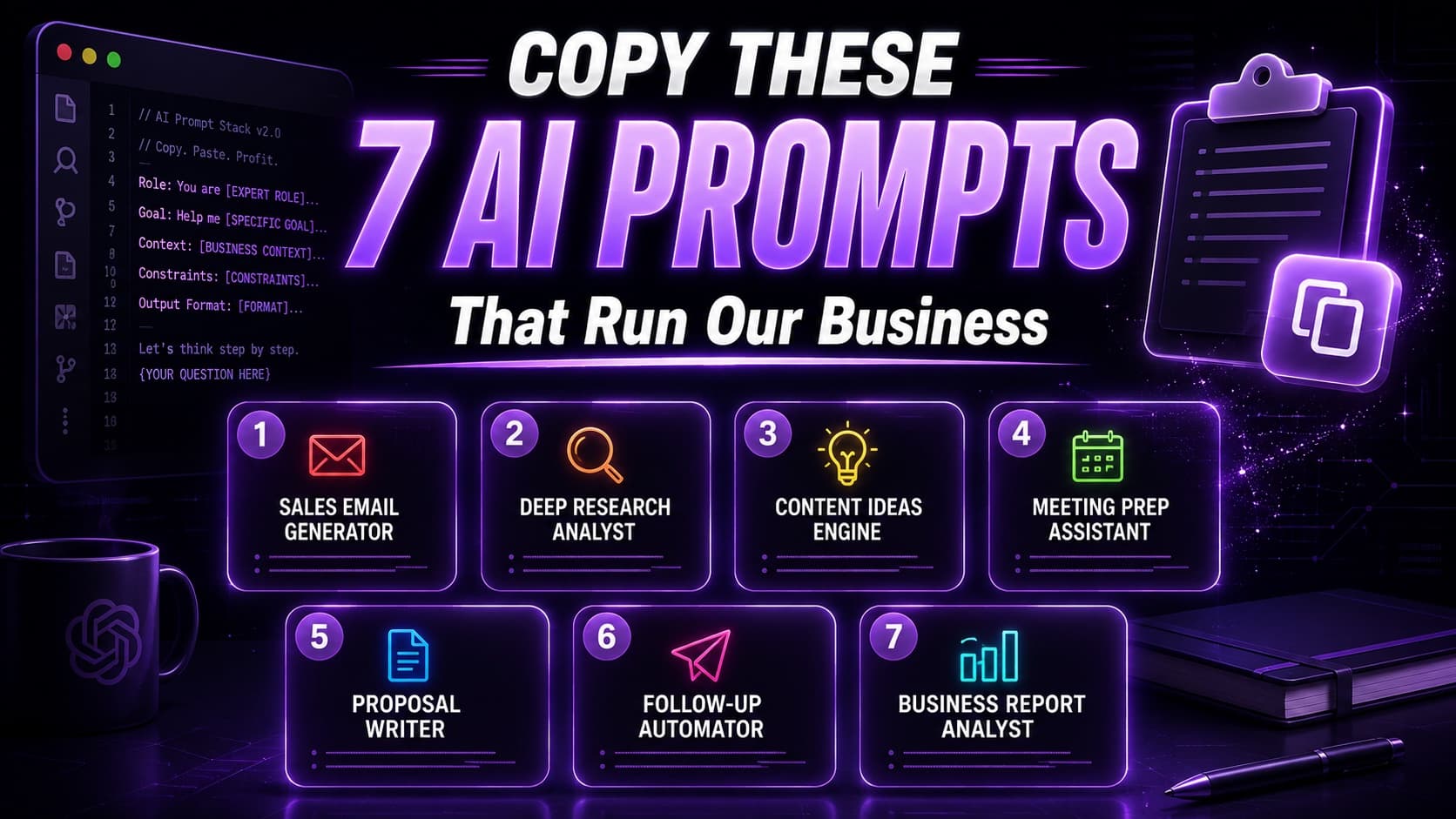
Seven prompts. That's what runs our business. Not seven tools, not seven platforms, not seven extra hires — seven prompts we paste into AI every day that handle sales outreach, client research, content, meeting prep, proposals, follow-ups, and client reporting.
Today we're giving you the entire stack, word for word. Copy them. Swap the brackets for your own business. Start using them today.
Prompt 1 — The Sales Email Generator
What it does: writes personalized cold outreach that doesn't sound cold.
You are a senior sales strategist. Research [COMPANY NAME], then write a personalized cold email to [PERSON/ROLE]. Reference their recent news, their likely challenges based on their industry and stage, and one specific way we can help. Keep it under 100 words. Tone: direct, warm, no fluff. No generic opening lines. End with a clear, low-commitment ask.
Why it works: the AI researches the company before it writes a single line. The email references something real instead of a templated "I noticed your company..." opener — so it doesn't feel templated, because it isn't.
Prompt 2 — The Client Research Brief
What it does: prepares you for any meeting in two minutes flat.
Research [COMPANY] and [PERSON NAME, ROLE]. Give me: their recent news or milestones (last 90 days), company stage and likely priorities, potential objections they might raise about working with us, and three conversation starters that show I've done my homework. Format as bullet points I can scan in two minutes.
Why it works: you never walk into a meeting cold. Every call feels like you already know them — because you do. Our result: client satisfaction scores on calls went up 40%.
Prompt 3 — The Content Idea Machine
What it does: generates scroll-stopping post ideas matched to what your audience is already talking about.
You are a content strategist for a B2B [YOUR NICHE] company. Scan today's trending conversations in [YOUR TOPICS]. Generate 5 post ideas with hooks that would stop a CEO mid-scroll. For each, give me: the hook (first line), the angle (unique perspective), and the key insight (what makes it valuable). Prioritize contrarian takes and data-backed claims.
Why it works: you're always posting about what your audience is already thinking about, and relevance is what drives engagement — not posting frequency. Our result: 3 posts a day, with content impressions up 20x.
Prompt 4 — The Meeting Prep & Agenda Builder
What it does: turns every meeting into a strategic conversation instead of a status update.
I have a meeting with [CLIENT NAME] in one hour. Based on context: [paste recent notes/emails]. Generate a meeting agenda that includes: two strategic questions I should ask (that show I'm thinking about their business), one insight or recommendation I can share that adds immediate value, and a clear next step to propose at the end. Keep it actionable and specific.
Why it works: meetings go from "let's catch up" to "here's exactly what we're solving," and clients notice immediately. Our result: meetings shortened by 35%, action items up 3x.
Prompt 5 — The Proposal Writer
What it does: drafts a custom, specific proposal in about 20 minutes instead of half a day.
Write a custom proposal for [PROSPECT NAME]. Their company does [X]. Their primary challenge is [Y]. Our solution addresses this by [Z]. Structure the proposal as: Executive Summary (2-3 sentences), Problem Statement (their specific pain), Proposed Solution (exactly what we'll do), Timeline (realistic phases), Investment (our pricing), Expected ROI (conservative estimate with reasoning). Keep it under two pages. Tone: confident, specific, no generic filler. Every sentence should apply only to them.
Why it works: no more half-day proposal marathons — AI handles the structure, you handle the strategy. Our result: proposal creation went from 4 hours to 20 minutes, with close rate unchanged because quality stayed high.
Prompt 6 — The Follow-Up Sequence Generator
What it does: writes a 3-email sequence that re-engages a lead who went cold.
This lead [NAME, COMPANY] went cold after our initial conversation about [TOPIC]. Based on their situation: [brief context]. Generate a 3-email follow-up sequence. Email 1 (Day 5): Add value with a relevant insight or resource — no ask. Email 2 (Day 10): Share a brief case study of someone in a similar situation. Email 3 (Day 15): Direct, honest ask with a clear calendar link. Keep each under 75 words. Tone: helpful, not desperate. Each email should stand alone.
Why it works: most deals don't die from "no" — they die from silence. This prompt makes sure you always follow up, always with value, and never sound pushy. Our result: recovered 23% of cold leads — revenue we would otherwise have left on the table.
Prompt 7 — The Weekly Report Generator
What it does: creates a client-facing update in about two minutes.
Based on this week's data: [paste metrics, notes, or updates]. Generate a client-facing weekly report for [CLIENT NAME]. Include: three wins or progress points (specific, measurable), one area that needs attention (with proposed solution), and one strategic recommendation for next week (actionable). Keep it scannable and under 300 words. Tone: professional, confident, proactive. No filler paragraphs.
Why it works: clients feel informed without needing a meeting, which demonstrates value constantly — and it takes two minutes instead of forty-five. Our result: client retention and NPS both improved. "I always know what's happening" became the most common piece of feedback we got.
The Math
- Sales emails: 4% response → 19% response
- Client research: 30 min prep → 2 min prep
- Content: 2 posts/week → 3 posts/day
- Meeting prep: winging it → a strategic agenda
- Proposals: 4 hours → 20 minutes
- Follow-ups: forgotten → automated
- Reports: 45 min each → 2 min each
Total time saved: roughly 40 hours a week. Total cost: nothing beyond the AI access you probably already have.
How to Use This Stack
- Copy each prompt exactly as written.
- Customize the brackets — [COMPANY], [NICHE], [CLIENT NAME] — for your business.
- Save them somewhere you can grab fast: Notion, bookmarks, pinned notes.
- Use them daily — the compound effect kicks in after about a week.
- Iterate — when you get a great output, note what made it great and refine the prompt.
Not seven tools. Not seven platforms. Not seven extra hires. Seven prompts we paste every day — and about 40 hours a week we don't have to spend on work that used to eat the whole day.
These seven are our general stack. Every business is different, though — the brackets you fill in, and sometimes the prompts themselves, should change based on your industry, your workflows, and where your team's actual gaps are. That's the audit we run for free. Talk to an AI Strategist and get a free AI assessment →