Write Any Business Email in 30 Seconds: The PASTE Framework
Most AI-written emails get deleted on sight because the instructions behind them are lazy. PASTE is a five-input framework — Purpose, Audience, Style, Tone, Examples — that turns any AI chat into a 30-second draft that actually sounds like you.
By Garvit Jain, Vardhan AI
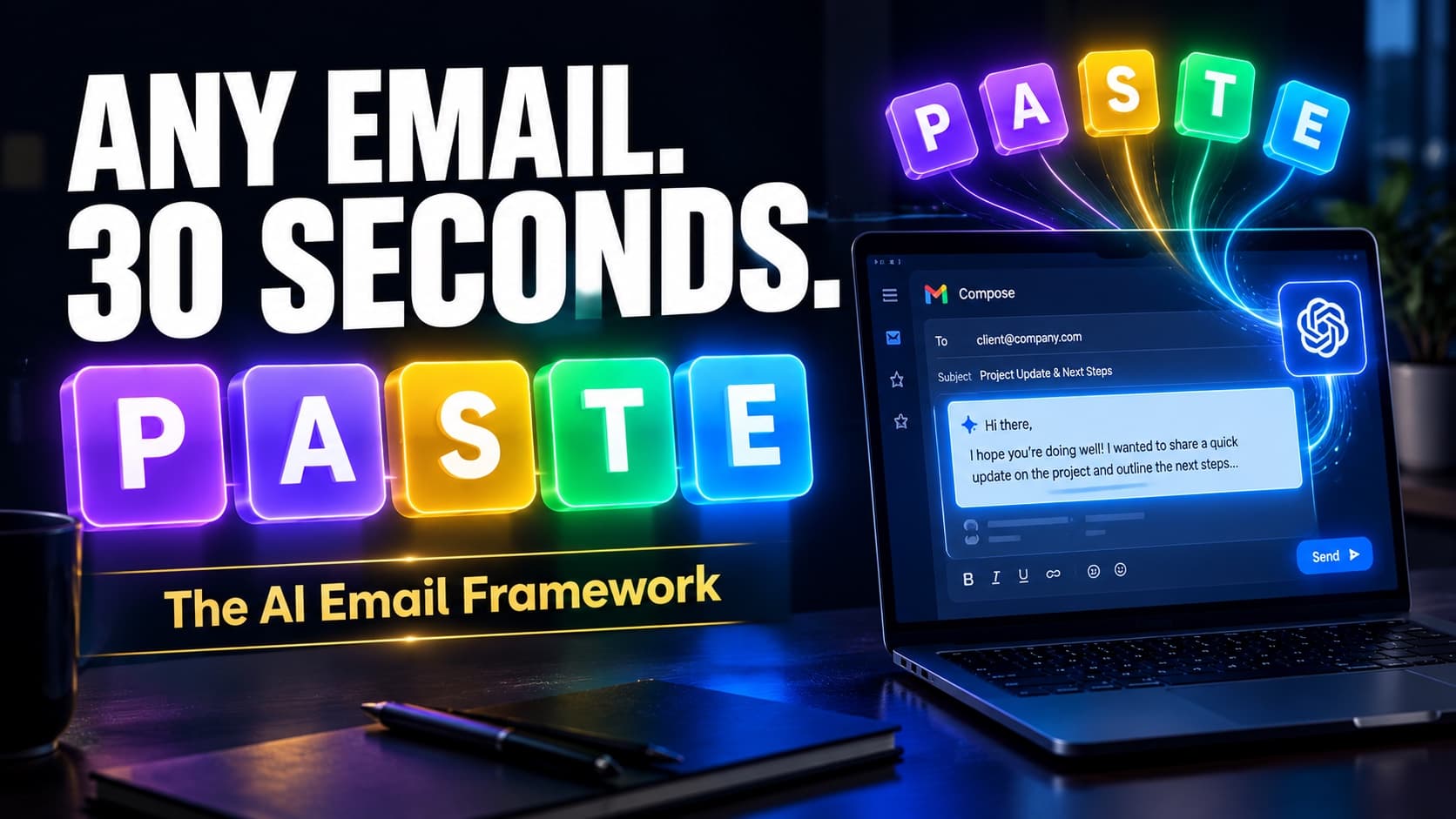
You write 50+ emails a day — sales follow-ups, client updates, internal requests, proposals, escalations — and each one costs 10-15 minutes: staring at a blank screen, rewriting the opening three times, digging through old threads for something to copy. Add it up and that's 4+ hours a day, half your workday, gone on something that should take thirty seconds.
Why 'Just Use AI' Doesn't Work
Most people who try AI for email get garbage back: generic, robotic, clearly-not-human output they'd never actually send. The reason isn't the AI — it's the instruction. "Write a follow-up email" is an action, not a brief, and it produces exactly the kind of email everyone deletes on sight.
The difference between a useless AI email and a perfect one was never the model. It's your input.
The PASTE Framework
Five inputs. Thirty seconds. A perfect email every time — in your own voice, not a robot's.
P — Purpose
What do you want to happen after they read this email? Not "send a follow-up" — that's an action, not a purpose:
- "Get the client to confirm the project start date"
- "Book a 15-minute call this week"
- "Get approval on the revised budget"
One sentence. A specific, named outcome.
A — Audience
Who are you writing to? This changes everything about how the email should read:
- CEO → Bullet points. No fluff. Bottom line first.
- New hire → Encouraging. Clear next steps. Assume nothing.
- Angry customer → Empathy first. Solution second.
- Vendor → Professional. Specific. Reference numbers.
Tell the AI who they are and what they care about, and the entire draft shifts.
S — Style
Three options that cover 95% of business communication:
- Formal — Banks, legal, enterprise clients, official requests
- Casual — Co-founders, close colleagues, startup partners
- Friendly-firm — The sweet spot for most business emails: professional but human
Match the relationship, not the topic.
T — Tone
One word that changes the entire feel of the email: urgent, confident, empathetic, apologetic, enthusiastic, direct, warm.
"Urgent" turns a follow-up into a nudge. "Empathetic" turns a complaint response into retention. Of the five inputs, this single word has the biggest impact on how the email actually lands.
E — Examples
The secret weapon. Give the AI one sentence that shows how you naturally write:
- "I tend to open with a personal note before getting to business"
- "I'm direct — no small talk, just the ask"
- "I use short sentences. Punchy. No corporate speak."
This is what makes the AI sound like you, not a robot.
PASTE in Action
Here's what the five inputs look like for a real, high-stakes email — a cold outreach message to a VP who gets 50 of these a day.
- Apology email — P: retain the client and prevent churn. A: frustrated long-term customer after a service failure. S: formal. T: empathetic and solution-focused. E: "I acknowledge the problem before explaining anything." Result: an email that rebuilds trust instead of making excuses.
- Internal follow-up — P: get the quarterly report by Friday. A: busy team lead who tends to deprioritize documentation. S: friendly-firm. T: direct but supportive. E: "I use 'we' language and offer help rather than just deadlines." Result: gets action without being the annoying email person.
The Math
The five inputs cost you nothing extra to think through. This is what changes once they're your default:
- Time per email: 10-15 minutes → 30 seconds
- 50 emails a day: 4+ hours → 15 minutes
- Drafts needed: multiple rewrites → first draft is the final draft
- AI output: generic and robotic → sounds exactly like you
- Quality: inconsistent → perfect every time
How to Start Today
- Open any AI — ChatGPT, Claude, Gemini all work.
- Before your next email, write 5 lines: P (your purpose), A (your audience), S (your style), T (your tone), E (your voice example).
- Add one line: "Write an email based on these inputs."
- Send it — maybe tweak one line first.
Do this for a week. You'll never write emails the old way again.
Five inputs. Thirty seconds. The difference between an email that gets deleted and one that gets a reply was never the AI — it's what you tell it before it starts typing.
Beyond Individual Use
The PASTE framework works for one person. Now imagine it running across your entire team:
- Sales reps sending perfect follow-ups in their own voice
- Support teams writing empathetic responses at scale
- Managers sending clear delegation emails instantly
- Founders doing investor updates in minutes
That's what we build at Vardhan AI — AI communication tools that learn each person's PASTE defaults and draft emails automatically, without the five lines typed in every time. Talk to an AI Strategist and get a free AI assessment →